
The Avalanche Stopped Four Feet From the Edge
Matthew Turley on the slide that made the ski film Steep, the friend who fell down Denali a week later, and the day he did the math on twenty years of steep skiing
Episode 3 · The White Squall Podcast · 1 hr 13 min
Guest: Matthew Turley — adventure and commercial photographer, ski mountaineer
The Story
For an hour, they threw snowballs off a cliff.
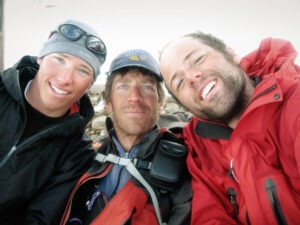
There was nothing else to do. Matthew Turley and two teammates — Andrew McLean and Dylan Freed — were standing on a rock pedestal in northern Iceland, big enough to pitch a few tents on, waiting on a radio call from a film crew setting up on the summit above them. Below the pedestal was five or six hundred feet of cliff, not quite vertical, stepped, ugly. The game was to see whether you could throw a snowball far enough to clear the whole thing.
They got close. They never quite got one all the way down.
This was the middle of a month in Iceland shooting for Steep, the 2007 documentary about big-mountain skiing. It was supposed to be their day off — a peak they’d been eyeing for weeks with a couloir that corkscrews off the summit and drops through a narrow slot in the ridge. They’d asked the crew for one day to just ski, without the circus. The crew agreed, then called back to say they could get to the summit with the search-and-rescue team’s snow machines and film from up there. Fly on the wall. For real this time.
Two hundred yards from the summit
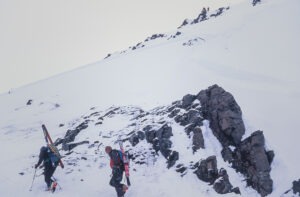
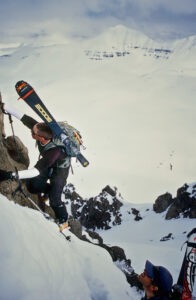
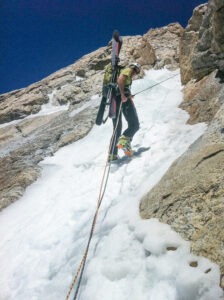
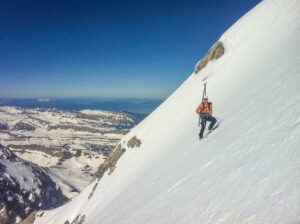
When the radio call finally came, the three of them turned and started climbing in earnest. Skis on their packs. Whippets in hand — ski poles with an ice axe head built into the grip, invented by the man leading the trip.
The slope was forty-plus degrees and firm. Matt led, kicking steps, up through a small cliff band that was more fun than frightening, using his hands, mixed ice and snow. All three cleared it. Above them was clean, open snow and a camera on a tripod pointed straight down the fall line.
He kicked in one more step.
“And all of a sudden the entire slope just gives way. You have that sudden drop feeling.”
The snow shattered into blocks the size of hay bales. Big, heavy, hard — not the soft slab most people picture. Matt went over the little cliff band he had just climbed and was surprised by how gently he landed, because by then he was moving inside so much snow it was like landing in water. Then he got turned around, head down, skis still on his back, body surfing.
And he looked up and saw the balcony coming.
The worst thing about knowing exactly what’s coming
This is the part that separates this story from every other avalanche story.
Matt had spent the previous hour running physics experiments off that lip. He knew the trajectory. He’d watched thirty snowballs do it. Now the same edge was rushing at him and it looked, he says, like an Olympic ski jump.
“I knew exactly what was over that edge and exactly what the trajectory of all those snowballs was. It was kind of this weird thing to have just been testing out the kinematics of what an object would do off this lip. And then be in the position of: now it’s my turn.”
There was no question in his mind about the outcome. The only open question was how long it would take, and he remembers the specific and awful realization that there was going to be a lot of airtime — that he was going to be very conscious of all of it.
He remembers thinking about his family. He was engaged at the time. He remembers thinking, this is going to hurt.
And then, a meter and a half from the lip, the snow he was in stopped.
Three improbable stops
Andrew stopped too, about the same distance from the edge, twelve or fifteen feet to Matt’s right, invisible behind a tongue of snow that had piled up between them. Dylan, far right, got a Whippet into something below the prow of the balcony and held on while chunks of ice came past him — he came out of it with a cut face and a beaten-up hand, and the least probable stop of the three.
The snow on either side of them kept accelerating. Matt describes it as eddying out in the middle of a river while the river keeps going. It was loud enough that people in a town five miles away came out of their houses to find out what the noise was.
He was buried from about the waist down. It took him a minute to kick free. Then he screamed for Andrew, and Andrew answered, and the two of them screamed for Dylan.
For thirty or forty seconds, nothing.
It was Dylan’s birthday.
What actually kills people in avalanches
Ask a backcountry skier what an avalanche does to you and they’ll describe burial: the transceiver, the probe, the shovel, the fifteen-minute window. That’s the training, and it’s the right training, because that’s how skiers die.
It isn’t how mountaineers die.
“Mountaineers get killed by avalanches by being pushed off of a mountain. Skiers typically die in avalanches by being buried.”
Roughly sixty percent of avalanche deaths are trauma during the slide — trees, rocks, cliffs — and burial takes most of the rest. In Iceland, burial never entered the equation. There was plenty of snow to bury them in. But the way that particular avalanche was going to kill somebody was by sweeping them over an edge, and everybody in it knew that from the first second.
And then they went back to work
There was still more than a week of production left.
They took the next day off. Then they were back on the same kind of terrain, and stayed on it for another week, and finished the film. A week after Matt got home from Iceland, he flew to Alaska to climb and ski Denali.
On that trip, a friend on his team fell down the Orient Express — the couloir on Denali named for the people it has killed — and became the first person to survive it. Matt didn’t see the fall. He was on the rescue team that went up and brought him down, and went back the next day to carry off all of his bloody gear.
That friend is Ed Maginn, and he told his side of this exact story in episode four of this show. Two men, one couloir, one week in 2006, twenty years of distance, and two completely different vantage points on the same afternoon. If you listen to one after the other, you get something neither episode has alone.
The casino
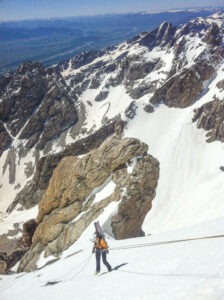
Matt kept skiing hard for another four years. In 2010 he skied the Grand Teton — a line first descended by Bill Briggs in 1971, and a goal Matt had carried since he was a teenager, close to twenty years of wanting one thing.
He got it. It was the most sustained technical skiing he’s ever done. It was also, in his words, not a great day. It warmed up faster than forecast and the mountain started dropping rocks on them.
“You’re worried about falling — you can’t fall, you can’t survive it, even a small fall. So you’re hyper focused on each turn being perfect. And then you have this other factor that doesn’t care about how good your turn is. The mountain is just shooting cannons at you.”
He realized, in the middle of the thing he had wanted for two decades, that he wasn’t enjoying it.
That, plus Iceland, plus Denali, plus a childhood friend killed on the South Teton two months before Matt’s Grand descent — swept off a two-thousand-foot cliff by a slide he was never buried in — plus another friend dead the following winter, added up. Not to a single decision. To an accumulation.
“If you play long enough, it doesn’t matter who you are, how good you are, what you know or think you know — it’s gonna catch up to you. It felt more like a casino where maybe you’ve won, but in the end you’re gonna lose all your money here.”
At the end of 2010 he stepped back.
What This Episode Is Really About
It would be easy to file this as a survival story. It isn’t, quite.
Matt didn’t quit. He still skis alone, which is close to taboo in the backcountry, and he’d tell you plainly that some people would call what he does now risky. What changed isn’t his appetite. It’s that he found the outer edge of his own envelope by going past it, and then came back inside and stayed there.
Brandon calls it calibration — the way you tune a guitar string past the note and bring it back down, or push a photo too far in the edit and pull it until it’s right. You don’t find the line by staying well behind it.
“I found that limit. I went past that limit, and that’s what scared me. I have no business being on the other side of this line for any more time than I have to.”
The other half of it, which Matt is careful about, is that none of this is an argument for staying home. He quotes Helen Keller — life is either a daring adventure or nothing — and points out that the same passage says avoiding danger is no safer in the long run than exposure to it. You can sit on the couch. There’s a whole menu of things that will kill you there too.
Rock climbing, he says, is one of the safest sports there is. Sport climbing at your local crag, with reasonable systems, and the most dangerous part of your day is the drive to the crag. It’s the same activity that kills people, and the difference isn’t the sport. It’s what you’re doing inside it, how often, and whether it’s the kind of thing that tempts you to keep escalating.
That’s the real subject of this conversation. Not whether to take risks. How to know where your own line is — and what it costs to find out.
Key Moments
| Time | |
|---|---|
| 00:00 | “Now It’s My Turn”: Head First in an Avalanche |
| 02:07 | Meet Matthew Turley: Adventure Photographer and Ski Mountaineer |
| 03:52 | “I Climb So I Can Mountaineer, and I Mountaineer So I Can Ski” |
| 14:19 | The Couloir Where Brandon Lost an Edge Above a Cliff |
| 16:45 | Backcountry vs. Resort: No Fences, No Signs, No Ski Patrol |
| 22:19 | Alaska Math: One Slip on Wet Rock and a Week-Long Rescue |
| 24:34 | How a Photographer Ended Up in the Ski Documentary Steep |
| 29:43 | “Are You Going to Pay for It?”: How Iceland Got Funded |
| 31:25 | A Month in Iceland: Stormed Out With a Crew Fresh Off Survivor |
| 35:20 | The Day Off That Wasn’t: One Peak, One Corkscrewing Couloir |
| 37:16 | An Hour on the Balcony, Throwing Snowballs Off the Cliff |
| 40:42 | The Slope Gives Way: Hay-Bale Blocks of Snow, Head First |
| 43:56 | Stopped Four Feet From the Edge |
| 48:22 | It Was Dylan’s Birthday, and Nobody Could Hear Him |
| 49:30 | How Avalanches Kill: Burial vs. Being Swept Off a Mountain |
| 51:38 | What It’s Like to Have Your Near-Death Experience on Film |
| 54:27 | 240 Frames a Second: Why Time Slows Down at the Worst Moment |
| 1:02:37 | One Week Later on Denali: Ed Maginn and the Orient Express |
| 1:04:32 | Skiing the Grand Teton: A 20-Year Dream, and Rockfall |
| 1:08:45 | Dan Osmond’s “Life Wish” and Where Matt Draws the Line |
Terms Used in This Episode
Couloir — a steep, narrow snow gully running down a mountain face, usually walled in by rock. The natural line of descent on a big peak, and also a terrain trap.
Whippet — a ski pole with an ice axe pick built into the grip, so you can self-arrest without dropping a pole and grabbing an axe. Designed by Andrew McLean while he was an industrial designer at Black Diamond in 1995; it reached retail in 1996. Dylan Freed stopped himself with one on this slope.
Skinning — climbing uphill on skis with fabric strips stuck to the bases, whose nap glides forward and grips backward so the ski won’t slide out from under you. How you earn your turns.
Crown — the fracture line at the top of an avalanche, where the slab pulled away from the snow it was sitting on. Matt and Dylan climbed back up to it afterward to measure it and figure out what they’d missed.
Slab — a cohesive layer of snow sitting on a weaker one. When it fails, it fails all at once. This one broke into hay-bale-sized blocks, which is a hard slab; a soft slab, more typical of Utah, behaves very differently.
Terrain trap — any feature that makes a slide worse than the slide itself: a gully that piles snow deep, a stand of trees, a cliff at the bottom. The Iceland slope’s terrain trap was a six-hundred-foot drop.
Benighted — caught out by darkness before you can get back. In central Idaho, with a six-mile flat approach on either end of your day, an ordinary problem becomes a serious one.
Depth hoar — large, weak, sugary snow crystals that form near the ground. Andrew McLean’s write-up of this trip describes their camp collapsing into bottomless depth hoar formed over Iceland’s thermal ground.
Resources
Matthew Turley
- Matthew Turley Photography
- Matthew Turley on Instagram
- Communication Arts feature on Matthew Turley (January 2014)
The Film
The Others Who Were There
- Andrew McLean — “Iceland 2006 Trip Series” — his own account of this trip
- SKI — “Known Unknown: Dylan Freed” — the third skier on the slope
- WildSnow — how the Whippet came to be — the tool Dylan stopped himself with, designed by the man leading the trip
Context
- Teton Gravity Research — Revisiting Bill Briggs’ First Descent of the Grand — the June 1971 first descent that became Matt’s twenty-year goal
- The White Squall Podcast, Episode 4: Ed Maginn — the other side of the Denali story Matt tells at 1:02:37
The Show
One Last Thing
The detail that stays with me isn’t the avalanche. It’s the hour before it.
Three men on a rock, bored, throwing snowballs off a cliff to see if they could clear it, because that is what people do when they’re waiting. And that hour of goofing around is the exact reason Matt knew, with total precision, what was about to happen to him — which turned a few seconds of chaos into a few seconds of certainty.
Most of us will never be in an avalanche. Every single one of us has spent an hour doing something pointless right before something serious. That’s not a mountaineering story. That’s just Tuesday.
Go listen to it.