
1: Jean Krejca | Cave Diving Disaster in Utah’s Deepest Cave
The Story
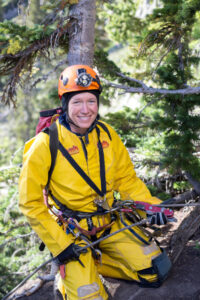
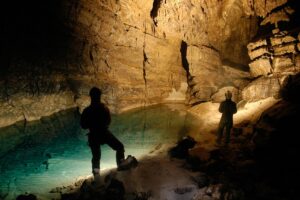
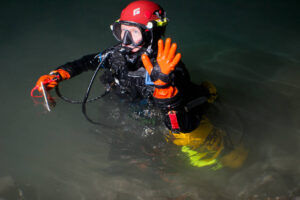
In August 2018, a small team gathered at Tony Grove in northern Utah to push the terminal sump of Main Drain Cave.
Main Drain is the deepest cave in Utah. The entrance sits above 9,000 feet in an alpine glacier basin, and the passage runs 1,227 vertical feet down from there through a chain of technical drops, including a pit called Kilo. At the bottom is water. Beyond the water, in theory, is more cave — dye tracing had already proven the stream reappears at a spring miles down Logan Canyon and thousands of feet lower in elevation. Somewhere between here and there is a lot of undiscovered cave.
Getting a diver to that water is the hard part. Jean puts the logistics at 90% of the total effort: roughly twenty cavers hauling scuba tanks down a series of vertical drops, day after day, on a schedule that asks people to descend a 1,227-foot alpine cave on a Monday, a Wednesday, and a Friday. As Jean puts it, the tanks are “kind of bombs. You don’t want to drop them.”
By the time she and dive partner David Moore reached the sump on day one of the 2018 push, the trip had already started going wrong. Floods the previous year had broken the dive line and pushed the loose pieces into what divers call entanglement hazards. Clearing and repairing it burned two-thirds of their gas instead of the one-third they’d planned.
Then something genuinely strange: the second sump was gone. The flood had blown out whatever was damming it, and where they’d previously had to dive, they simply walked. Beyond it lay virgin passage — a narrowing bedrock canyon with a stream running down it, ending at a waterfall and a third sump nobody had ever seen.
They dove it anyway. It looked like chocolate milk. They found no way on.
The accident happened afterward, back at the main sump, around midnight, with the last protein bar already eaten. Jean’s dry suit zipper snagged. David got a grip, pulled hard, bloodied his knuckles across her chest, and forced it past the bad tooth — and the entire metal zipper fell open behind it. Unfixable.
Between Jean and the surface: five hundred feet of flooded passage at eighty to ninety feet deep, in water her dive computer read at 38 degrees, with no functioning exposure suit.
The alternative was waiting alone, without food, a sleeping bag, or a stove, for a minimum of four days and more realistically six, while David exited the cave and drove to Salt Lake City for gear. She didn’t think she’d survive it.
So they made a plan: strip everything non-essential — including David’s caving helmet — and treat Jean not as a diver but as a load. She would swim for herself as long as she could. When she couldn’t, he would carry her.
What follows on the recording is one of the more remarkable pieces of first-person description I’ve had on a microphone. Jean loses dexterity in her fingers first, then her wrists, then her elbows. Her flooded suit turns her negatively buoyant, so she stops swimming and starts crawling along the bottom, dragging tanks, throwing her arms and legs “around like they were golf clubs” using only her shoulders and hips.
“It’s really weird,” she says. “Just like what it must be like to be paralyzed. And I guess I was just paralyzed.”
She made it. She shook uncontrollably for twenty minutes on the far shore while David stripped her out of the wet gear and got warm water into her.
Then, the next day, he dove the sump again. Alone. To retrieve the tanks — because some of them belonged to other people.
What This Episode Is Really About
Three things stuck with me after this conversation, and none of them are about caves.
Slow disasters are harder than fast ones. Jean makes the point that most accidents arrive without warning — a fall, a rockfall, a kayak flipping. This one gave her an hour to stand in the dark and fully comprehend her situation. She and David talked through sixteen scenarios. Plan A through plan K. That’s not panic. That’s the opposite of panic, and it’s a much rarer skill.
Sunk cost will kill you, and knowing that doesn’t make you immune. Jean names it out loud when they’re staring into the chocolate milk: they’d hauled gear for days, and every hour of that effort was quietly arguing for a dive they’d otherwise skip. She dove it anyway — and was still able to say, out loud, in the moment, that sunk cost was in the room. Naming your own bias while it’s operating on you is about as good as any of us get.
Turnarounds are where people die. She and I both circle this one. In caving it’s called “outhead” — the pull toward the exit that makes you drop your guard, take the shortcut, stop double-checking. The mountaineering literature says the same thing about descents. The objective is not the summit. The objective is the parking lot.
Key Moments
Every timestamp below is a link target. If your site builder supports it, make each one jump the embedded player to that mark — Captivate’s player accepts a ?t= parameter in seconds. If it doesn’t, plain text is fine; people are used to scrubbing.
00:00 — “He’s Looking at Me Like I’m Gonna Die Here”
01:57 — Meet Dr. Jean Krejca: Biospeleologist, Cave Diver, Explorer
03:17 — Her First Wild Cave: Mystery Cave, Missouri, and a Carbide Lamp
04:22 — Lips on the Ceiling: Surviving a Low-Airspace Crawl
05:32 — Why a Dry Caver Became a Cave Diver
09:06 — Gas Management: The Number One Risk in Cave Diving
09:30 — “Diving by Braille”: Losing Up and Down in a Silt-Out
12:21 — Alpine Caving vs. Regular Caving: Why Cold Is the Real Killer
14:28 — How Jean Got Recruited to Main Drain, Utah’s Deepest Cave
18:10 — Why Hauling Gear Is 90% of a Deep Cave Dive Expedition
20:29 — “They’re Kind of Bombs”: Carrying Scuba Tanks Down a 250-Foot Pit
21:26 — The 2016 Dive: 500 Feet of Sump at 90 Feet Deep
25:56 — Flood Damage, a Broken Dive Line, and Entanglement Hazards
29:32 — The Sump That Vanished: Walking Through What Used to Be Underwater
33:19 — Diving Into a Pool of Chocolate Milk
43:58 — The Dry Suit Zipper Fails, 1,227 Feet Underground
48:51 — Doing the Math: Six Days, No Food, No Way to Stay Warm
50:24 — “Treat Me Like a Load, Not a Diver”
1:01:00 — Losing Her Hands, Then Her Arms, on the Dive Out
1:05:46 — Coming Back to the Light
Coming Up Next (00:00)
Coming up next on the White Squall podcast.

Speaker 2 (00:03)
But this thing was really weirdly slow motion because here you are. I'm standing in dry cave. I'm cold. I'm tired. I'm hungry. I'm a little uncomfortable. But there's no train running me over. There's no, like, I'm not filling my lungs with water right now. I'm just standing in cave passage talking to my buddy.

And we're looking at each other and he's looking at me like I'm gonna die here.

WS Podcast Intro (00:35)
Man overboard!

Vocals (00:48)
Hello, my friends, and welcome to another episode

Music (00:50)
you

Vocals (00:51)
of the White Squall Podcast. I'm Brandon Kowalis, Cave Explorer, Outdoorsman, and host of this show. In this podcast, we dive deep into the incredible adventure stories of extraordinary people from all walks of life. Individuals who have pushed themselves or been pushed by outside forces far beyond their limits to brave the unknown. From the miraculous and heartwarming,

To the terrifying and death-defying, we'll examine how the lessons they've learned can inspire and guide us all. And if after this episode you're itching for more adventure and incredible insights, check out my latest book, Cursing Mountains. In this inspirational novel, I take readers on a journey into my own insights from the challenges I've faced as I've pushed myself beyond my own comfort zone, both above and underground. It is packed.

Full of timeless wisdom that can help you find direction along your own comfort zone expanding journey.

Boom Rumble (01:55)
you

Jean Intro (01:57)
Today's guest

is Dr. Jean Krejca Jean earned her PhD in evolutionary biology, specializing in biospeleology, the study of cave-dwelling organisms. For many years, she served as the president and co-founder of Zara Environmental LLC, which is an environmental consulting firm based in Texas. Her work has led to significant contributions to science, including

Leading deep cave biological surveys for the National Park Service, and helping discover and describe subterranean species that are completely new to science, ranging from cave millipedes to eyeless predators. Beyond her consulting an academic career, Gene is a world-class caver, known for taking on intense multi-mile expeditions into some of the deepest and most challenging cave systems.

on Earth. Her skill as an explorer and an underground photographer have allowed her to document species and geological formations that few humans will ever see.

And now for my conversation about one of the most insane underground entrapment stories with doctor Jean Krejca

Boom Rumble (03:15)
you

Speaker 2 (03:17)
I was super lucky as an undergrad in my first year of college to run into a caving club. they were properly affiliated with the NSS, which is the National Speleological Society, and that is a group that has kind of regional subgroups under it called Grottos. And so I became involved with this grotto, which is like a club, a caving club. And the very first cave they took me to was a wild cave in Missouri called Mystery, and it's something like probably 12 or 15 mile

long cave and great section of stream passage in there

And the very first time I went caving, this old dude in the caving club showed me a carbide light and put that on my helmet. Nice. he like you know cupped over where the acetylene gas was coming out and popped it on and everything and stuck it on a spade mount on my helmet. And it seemed very kind of Dungeons

and Dragons to me, too, also, which I was into in high school. And then the second wild cave was was a survey

Trip using a borrowed wetsuit in low air.

Speaker 1 (04:22)
and when you say low air, so I'm curious on this. You say low air, you mean like low air space or high CO2 levels?

Speaker 2 (04:30)
Great question.

This was a low airspace. And so this was a place I remember it was a week night. It was like

We met up at like six PM or something. We didn't get to the parking spot till like eight o'clock at night, and then we stumbled around the woods for two hours until we finally found the cave. Right? This was the early nineties pre-GPS and whatnot. And we're trying to find this place again in the dark. When we finally got to the entrance, I thought, my gosh, okay, these people are probably gonna give up now. Now that they found the entrance, we're just gonna turn around and go home. They're like, No, we're gonna start this trip. And I'm squeezed into this borrowed wetsuit, and we had to dig out a gravel bar to let the water.

are lower enough, take off the helmet, invert the carbide lamp so you stick it in the bottom part of the spade mount and push it through like a little boat in front of you. And then lay on your back and just put your lips on the ceiling to get through this really a crawlway that also had low air in it.

Speaker 1 (05:27)
f how long did it go, like in the with the little airspace?

Speaker 2 (05:30)
not that far, maybe three or four body lengths.

Speaker 1 (05:32)
So not only do you explore these above water caves, but you're also a certified cave diver, which is kind of like the pinnacle of dangerous caving.

Speaker 2 (05:45)
Yeah, my trajectory of getting into cave diving was maybe a little not as typical as your average cave diver, because I was first into dry caving.

So the vast majority, I would say 95% of cave divers are not dry cavers. These are people that are really into scuba diving and want to increase their scuba diving to the next level.

for me though, I was really interested in caving and cave biology. And that took me to studying aquatic organisms that live in caves.

So for me I became interested in studying these species and then that led me to a desire to go farther into submerged cave passage. Which, like you alluded to, is

the activity has a really a bad reputation. It's basically just a high-stakes environment where small

problems can get really amplified really quickly.

Speaker 1 (06:44)
And what is the process I mean, it's not easy to become a certified cave diver, right? It's not like you go take a little basic class and then you've passed it off and then you're good to go.

Speaker 2 (06:53)
Right. At a minimum you go through an advanced diving certification and then three cave certifications that lead right that lead you to to full cave. but before you get those three certifications you also have to kind of apply to get into those and that requires at the minimum it's advanced open water.

Yeah, there's a whole bunch of skills that come along with cave diving that are generally applicable to diving, but particularly important in a cave setting, like one of them was kicking up silt. Well, along with that comes a real fine tuned buoyancy control. And so that is essentially being able to really dial in the ability to breathe in and breathe out without excessively raising your body or lowering your body, and then also to

be able to avoid touching the ceiling or the floor, because in a lot of cases both of them have silt. Like normally we think of the floor as having silt and dirt on it. But actually the ceiling oftentimes gets little little bits of of dirt or what divers call percolation attached to it. Where if you brush up against that ceiling or sometimes even just many times actually even just your bubbles, your exhale, go up and they hit the ceiling and they knock all the dirt down and the dirt just rains on you from the top.

It's also skills about managing a bunch of different things at once. Like oftentimes you have multiple air supplies. So you're not just looking at a single gauge to decide how much gas you have remaining, but you might be looking at

Two gauges, one on each tank, and then you might even have a bailout tank, and then you might also have a decompression tank that's set up with a different kind of gas mixture too. So depending on what depth you go to, you use different gas mixtures

and all of that has an effect of like, like if you have too much oxygen, you will convulse. Or if you don't have enough oxygen, your brain doesn't work very well. Things like this.

Speaker 1 (08:59)
you'd mentioned like silt and that. Like it's not just that it kind of rains down, but it it'll like completely murk up the water.

Speaker 2 (09:06)
Yeah.

Primary

risks I'd say is simply that you can't ascend to get to air. the number one problem is gas management, is how much air you have on board compared to how far it is to the nearest airbell, to the nearest place where you can go to the surface, take your regulator out, and just breathe. Because like of course you're in a cave and if you go straight up, you're just gonna hit your head on a rock and you won't find a place to breathe.

Speaker 1 (09:30)
And what about the visibility? Cause I because I've talked to divers that when they stir up the silt and the mud, I've heard that it's even hard to tell which way is up and down, like as you're floating there in neutral buoyancy that

Speaker 2 (09:43)
It's a peculiar experience, but yeah, when your ears fill with water, especially cold water, it kind of messes up your natural sense about which way is up and which way is down. And so you're far more likely to to not be able to recognize that explicitly. And then when that's combined with zero visibility, you can't actually see your bubbles. 'Cause in an open water situation, even if your ears are cold and full of water, you can just look around and see what way your bubbles are going. And even if it's the middle of the night

You know that your bubbles are going up. But in the case of a silt-out situation, it's it's much like you're just diving with your eyes closed, essentially. We call it diving by braille. And

It contributes to a lot of accidents that happen in caves where without your visual sense, if you, for example, lose track of the dive line, then it could take a long time to find it again in order to find your way out. And again, this goes back to the thing where you can't just like kick upwards and find the find a place to just go breathe if you get disoriented and you lose track of the dive line.

It makes in particular diving downstream a lot more of a challenge because basically if you create silt or a silk cloud

It can pass in front of you, and then everything in front of you is silted out. It also makes diving virgin passage, which of course most cave divers don't run into, but in the case of exploring caves, that is exactly what you're doing. It means that if you are running a dive line and there's a silt cloud in front of you, you don't actually have a sense of whether that dive line is forming what's called a line trap.

Which is where you might be slowly kind of turning one way to the left or to the right, and the shape of the passage is such that there's a notch on the left or right, which is common in like bedding plane partings, or maybe you're going up or down and you have a a ceiling notch or a floor notch.

And you are supposed to be pulling that line tight, but you could be pulling it into a notch that when you tie it off and come back to turn around is actually an impassable location. So there's all these nuances to to setting the line, and so it's a lot harder to do with zero visibility.

Speaker 1 (12:03)
Crazy. And I imagine too, like walking just down a regular cave passage, lights go out. You've you've like visually referenced behind you and in front of you, and you can feel gravity. And so you're like, okay, I can maybe kind of feel my way out.

Speaker 2 (12:16)
Absolutely, yeah. There it becomes really, really essential to stay on the line.

Speaker 1 (12:21)
so we talk about cave diving. let's talk a little bit about alpine caving. I wanted to get into that. So there's regular caving, like back in Tag, you've got a lot of walking, crawling passages and that kind of thing. And then you've got alpine caving, and I feel like there's a higher level, I mean, caves are risky in general,

But there's a lot more dangers potentially in alpine caving than than just your standard horizontal caving.

Speaker 2 (12:48)
of course a huge difference is just the cold. It's just the thermal extremes in alpine environment. A lot of times your body is in contact with the rock a lot, maybe your chest or your back as you're wiggling through something. And it really drains your energy when that cold rock comes in contact with your body. So that

Is something that especially typifies alpine caving, but also a lot of it is just really remote. The cave entrance itself might be.

hours from the nearest from like where you've parked and it could be even longer to the nearest like cell phone reception or emergency services or anything like that. Like overall caves, of course, you can't just send a helicopter in to pick somebody up. And that becomes just more and more extreme the more remote you get in terms of the availability to find help if something does go wrong.

Speaker 1 (13:44)
a lot of alpine caves are deep vertical caves. And I've like people will get down to the bottom and they climb maybe the first pit and they're tired. and now I've got a thousand more feet to climb. And it's like this mental game, I've got all this distance to go now, I'm exhausted. And it's like, how do you now deal with that instead of having a breakdown?

and the thoughts start swirling and then you get more tired as you're trying to climb.

Speaker 2 (14:10)
And I mean how often do you you try to measure how much gas you have left in your own internal tank, but you're going down, down, down, down on the way in, which repelling is far easier than rope climbing. So making those calculations can be yeah, it can be deceiving

Speaker 1 (14:28)
So can you tell me about how you first got wind of main drain cave

Speaker 2 (14:36)
So yeah, it was through the the caving communities this great group of people, right? That have that share interest in exploring these kind of bizarre and many times uncomfortable places. But so it's a bit of a small world there. Like we're pretty well connected across the country or so, I'd say. And there's so there's people we know in different

Different states that do different things. And I think somebody just got wind that I had been doing some exploration projects in Texas and had also done a little bit in Wyoming and just some other places in the western states,

I think there might have been an article about that bad medicine dive, which is similar environment, like of it being really cold, but not all the vertical work of main drain Anyway, it sounded sort of interesting. that I thought, I'll just come out and check it out anyway, maybe bounce to the sump and at least look at it.

Actually, found that for Alpine Cave, it was relatively pleasant for a deep alpine cave. Like there are definitely some narrow spots in there and some unpleasant places, but in the scheme of things, for being able to get down to 1300 feet in a cave that starts at 9,000 feet elevation, there's a fair amount of fairly

Enjoyable passage to go through. There's also a fair amount of uncomfortable passage too, of course, as you very well know. But we enjoyed our trip. We enjoyed our bounce trip. We didn't go all the way to the sump that time. We actually just went to there had to be a low spot.

Speaker 1 (16:09)
so what was the objective when they reached out to you to come check out main drain, talking about diving, what were they wanting to accomplish?

Speaker 2 (16:18)
So these guys had supported a former dive team that went through there. Josh Thornton and maybe Michael

Speaker 1 (16:25)
Michael Thorton

Speaker 2 (16:26)
Thornton. Yeah, that sounds right. brothers that operate a dive shop here. Mm-hmm. And

They had supported that team and that team had I think just lost some steam after a couple of attempts to get through that first sump. Right at the beginning of this first sump, there's some quite narrow areas and some navigating through boulders and it's a downstream dive. So it's not a

Not a simple process to get there's there's basically a big obstacle right at the beginning of the dive. And that had been attempted a couple of times, but even though that first obstacle hadn't been passed yet, some die tracing had been done in the area, and that die tracing had demonstrated a a great potential for depth, which is something that a lot of cavers are tracing

So the objective was definitely to push through the sump and extend the total depth of the cave.

Speaker 1 (17:21)
so you go in there, and you decide that it's it's doable. And I think

one of the biggest challenges in these like deep alpine caves and doing sumps is finding people who are physically able to do that. Because a lot of divers, all you have to do is you drive your car up to where you're gonna dive, and then you climb out and you walk a hundred feet to the the cenote or the ocean.

or the lake or whatever and then you're diving. Or you get on a boat, you take the boat out, and then you jump in the water. But with cave diving and especially in these alpine caves, you've got to go down through these relatively extreme caves

And then get down to where the dive is. And so there's a lot logistics. I mean, it's not just like, hey, we're gonna do this let's call up our friends and we'll just grab our tanks and we'll take it in there. Like it's not an easy process.

Speaker 2 (18:10)
I would say in the scheme of our efforts at Main Drain Cave, those logistics and the hauling and the getting everything down to the beginning of the dive is probably 90% of the work, truly. And even, you know, I'm I feel really fortunate to know so many amazing cavers out there, and that's also a huge part of having a successful project like this, is the connections within the caving.

community. And in particular, Bev Shade was a giant part of multiple years of the project in there

she has a ton of experience leading big cave expeditions down in Mexico and also stuff in Texas and in various other places, but she brought with that a network of people to call on and then also just like a really great umbrella understanding of the logistics involved. So it's not just calling your friends but it's also saying hey I need you to

able to enter the cave maybe every other day for three times or something, which actually is a big physical ask for a lot of people to be able to go into that cave on a Monday, a Wednesday, and a Friday. that in itself is a pretty big physical accomplishment for a lot of cavers.

Mostly people need a big rest after these days. They're long days underground and it's physically taxing. So it takes some recovery time. And having somebody like that

as part of the project basically made it happen. It would have been impossible without just this network of people like that. And so I really called on her for her organizational skills. Philip Reichwalder helped a ton with that too. He knows a lot of people. He was the one who was there on that first trip Also,

I called on David Moore to be kind of the expert on diving. So while I have cave diving experience, this guy has 10 times cave diving experience than compared to me or more. And basically he came into it more as a wet caver first, as a scuba diver first, with less confidence and security about the under about the dry caving part. But he just let me take the lead on that, and I let him take the lead on.

organizing and equipping and doing a bunch of practice dives with the with the kit and configuration we're gonna be using.

Speaker 1 (20:29)
so I was on the it was on the one of the Thornton's dives and I went in and stayed there while they did the dive and then hauling those tanks out and the gear, like that was that was monumental because I think they had like somewhere between nine and ten tanks in there, and not all of them were empty.

And then on top of that, you're like climbing ropes, there's bolts and you've got to cross the bolts and do traverses and all this while you're carrying all that weight and find people who are competent enough and strong enough to do that. it's a lot of logistics to take care of and a lot of coordinating and volunteer work to make this happen.

Speaker 2 (21:04)
It absolutely is. And they're kind of bombs. You don't want to drop them. Yeah. Hurt somebody.

Speaker 1 (21:08)
Yeah,

I'm carrying a bomb down a 250-foot pit. Hopefully it's attached properly. yeah. so anyway, so you you do all this prep work, you head down a thousand feet, and you come to the sump.

Speaker 2 (21:26)
Right. Yeah, so that sump is a long way down. It's actually isn't it more like twelve hundred feet?

Speaker 1 (21:31)
something? Yeah you're right it's like 1230 so Kilo pit

Speaker 2 (21:40)
Sounds about right. Yeah. So we had made a first dive in there in 2016.

So David and I had some familiarity with the Sump already. And because now we're gonna talk about the 2018 dive, which I think is ultimately where where the story is going. But so in 2016 we were able to pass through that initial obstacle that the prior dive teams didn't have the right resources and the right visibility conditions and stuff to get through.

Speaker 1 (22:11)
What was the obstacle then?

Speaker 2 (22:12)
this was

it's a r it's a tight it's a tight and a convoluted and a silty location very close to the entrance pool of the sump.

Speaker 1 (22:22)
Okay, okay, so you dive, so you've got the sump, you dive in, and doesn't it kind of angle downward?

Speaker 2 (22:27)
It does angle downwards, it's a bit funnel-shaped there at first, but then at the bottom of the funnel is just a big jumble of rocks.

Speaker 1 (22:34)
Okay.

Speaker 2 (22:35)
And because it's because of the way the water comes up in a flood and then recedes, that big jumble of rocks gets really coated with silt. And also

Because at that sump there is actually water coming into it, a trickle, but there's water coming into it and then water exiting it. So you're actually diving downstream at that point. So as you get kitted up at the beach there in that kind of silt funnel, all of the silt you're kicking up just while you're putting your gear on and sinking into the water and getting that, which the kitting up process is not insignificant, just that is making sure all your gaskets are properly sealed and all your

Regulators are functioning right and your gauges are reading good and just it's oriented in a way that you can get to everything and look at it.

while all that's happening, the silk cloud is growing below you. And so, and then also sometimes it's just the time of year. Like it might be that it rained recently or some snow melt happened recently. And the sump itself, even when you first arrived before you put your first foot in it, is already a little bit salty, already a little bit cloudy, a little bit milky, a little hard to see through. And I think at least one of those prior expeditions that was a problem that it just

natively was a little less clear and some other time had some gear configuration issues. So essentially there's a lot of obstacles to overcome to just start to get in the water. And so that first year, 2016, David and I did get through that first difficult spot and we got all the way through the first sump, which is about 500 feet long.

You can get through that sump and staying about eighty feet deep, but I think a lot of times my my computer would register a little closer to ninety feet just depending on where you were exactly in the passage.

Speaker 1 (24:27)
That's a good amount of depth.

Speaker 2 (24:29)
Yeah,

it's a solid dive. It's not insignificant. It's not just a little ceiling sucker kind of breath hold thing. And being like it's about four to five hundred feet long or so. So it's long enough, you know, also traversing enough passage. And there were a couple other, there's like a big turn somewhere in the middle there. And then also towards the end, there's a big angle of repose gravel slope that on varying years can get.

taller and actually much much skinnier. Okay. just because the floor shifts. The height of the gravel on the floor shifts, even though the ceiling is bedrock. But also that bedrock ceiling has some kind of snags and stuff on it. So you gotta be careful about running too close to it. But we had gotten through the prior year, rather two years prior in 2016 and gotten to another sump that was pretty close, maybe like a hundred, 150, 200 feet away, not very far away. Okay.

Speaker 1 (25:23)
So like dri dry past. How how long

Speaker 2 (25:24)
Dry passage and then yeah.

Speaker 1 (25:27)
does it take you to get through the sump to the dry past?

Speaker 2 (25:30)
So long, maybe once you're in the water, I mean getting kitted up can take almost an hour actually. But then once you are your head actually sinks down and you're really breathing off your regulators, you can do it in less than twenty minutes. Okay. Even like probably closer to between maybe twelve and fifteen minutes.

Speaker 1 (25:49)
Really? Okay.

Speaker 2 (25:51)
given all the dive line is intact, the visibility is decent and like conditions are good.

Speaker 1 (25:56)
Okay.

Speaker 2 (25:56)
And so in twenty sixteen we got as far as the second sump, which we called two step sump, so this next time in 2018, our plan was to push through two step sump. But a few things happened.

In the interim in 2017, there had been some flooding. And so the first thing we encountered in 18 was that the dive line was broken. So our route through that first kind of difficult spot where you have to wind your way through some boulders and there's some tight spots there. that was just kind of a mess of line that had been broken. And once the line gets broken, it winds up being in these.

these pieces of line that the floodwaters push up into funny places and those are what we call entanglement hazards.

Speaker 1 (26:48)
Mm.

Speaker 2 (26:48)
So so when we first went through that very first day in 2018, we actually spent quite a while. David in particular did a lot of that that lead exploration underwater, spent quite a while just pulling all these pieces of entanglement hazards together and wrapping them up and getting them out of the way and into a safe place. And then after you do that,

You have to repair the existing line because you always need a continuous line to get back to where you started. So this repair process took a little while. We spent a fair amount of time underwater getting through that sump that first time. Maybe I can't remember offhand, I have to look at the log, but it might have been like 30 minutes, you know, maybe double what we expected to spend. Because I definitively remember when we got through that first sump.

In 18 on the first day, it was we had used two-thirds of the gas in our bottles and we had intended to use one third.

And so it put us just it just kind of started off the day with like, okay, we need to be cautious. And also it just put us on what you're sort of always doing in these situations. I mean, this is kind of the definition of exploration, right? You're you're

You're constantly reassessing the risk at this moment. You can make all the plans in the world. And then today comes along and something happens that's a little different.

but that's what a great, you know, that's one of the great things about the a well-established team, two people working together, and just that camaraderie feel. You're like, hey.

Let's just speak out loud and acknowledge these things happen and talk through different scenarios and be real intentional about what we decide to do next. Thankfully, we also had a lot of gas, we had a lot of reserve gas, and we had a lot of exploration gas. So we decided where we were going to leave our tank configuration and that the best thing to do was continue moving forward. Because in our plans we had two dive days worth of gas.

And we also correctly assessed that as the trip went on, since we were camping underground, that our energy reserves would become less and less as the days went. And it would be better to push hard in the beginning when we had our most energy reserves and towards the end do easier objectives.

So we pulled together our remaining tanks, left what we needed to behind and started the trip to two-step sump. And then the next peculiar thing happened, probably related to this flooding the year prior, is that that second sump was gone.

It was just gone. It was gone. It was just air. There was no water there. Really?

Just walk

Speaker 1 (29:32)
You could just

Speaker 2 (29:32)
right through it.

And we had

Speaker 1 (29:35)
That's insane.

Speaker 2 (29:37)
looked all around for our footsteps and everything, and there was evidence of flooding, like 30 to 40 feet. Water level had increased so much. And there was even evidence of that in the right at the beginning of the sump, too, that any tracks or anything like that from two years prior were all gone. And then we saw fresh silt, you know, up quite a bit higher, 30 to 40 feet from the existing water level.

So something happened with that flood event, and it must have kind of blown out some kind of dam or downstream obstacle and made it so that we could just walk through the sump. I know, how

easy is that? Except then also that we kept walking and walking and walking, which was super cool because we got to a big room and some really epic virgin passage

that was amazing.

The passage turned to have a little bit different character than to where instead of a big open wide silt floor there was an it was a narrower canyon space with a bedrock floor and a the stream down into a smaller space in the bottom. And then ultimately that dropped over a little waterfall and then went to what I will now call a third sump,

And these things do happen in caves, not like it would be highly unlikely to happen with a really deep sump that's 80 feet, 90 feet deep. But two step sump was a really shallow sump. You know, we only ever drop down maybe ten feet or something. So it would have been, even if it was a dive, it would have been a really shallow dive.

Regardless, we did still get to another sump. And then we were like, wow, we have some new passage to survey. And of course, mapping and cartography is a big part of our objective and what we wanted to do. But back to that earlier discussion of where our energy levels would be on different days, we decided we should do the high energy things today. You know, our first day, we were both feeling good about it. And so we decided that we should push this next, this third sump on the first day.

Which meant going back to get some more tanks and bringing back over and going back and bringing back over and going back and bringing back over because of course to get to the main sump we had about twenty cavers helping us carry gear. And now between this sump and the next sump, there's two cavers. Right?

Speaker 1 (31:52)
Yeah.

Speaker 2 (31:55)
So it was only a thousand feet of passage between the two sumps, but we had trav tr to traverse it six times.

Speaker 1 (32:02)
my gosh. So that's like over a mile of walking. And it's not it's not like a flat, sandy, easy to walk floor, right? I mean, there's probably

Speaker 2 (32:10)
Exactly. There's boulders to climb over and there's a few like step across areas and there's just some kind of silty long steep areas where you kind of have to chip your heels into the into the ground to make sure you don't slip and stuff.

And so it's it's kind of exhausting. And we're carrying tanks, of course, each way. Well, one of the directions we're carrying tanks and the other way we're going back empty and then carrying tanks and going back empty carrying tanks. So we were able to get all of our gear over there in three round trips, but you know, six times traversing the passage. But by the time we got all that gear over there and got all kitted up again, it's like eight or nine o'clock at night.

And we started at, you know, six or seven o'clock in the morning. That's right. So like it's already kind of getting to be a long day.

And it was like you're looking down this waterfall into this kind of super awkward crack-shaped thing with no beach or anything to stand on, just like kind of vertical, not so vertical that you have to repel, but but a but a steep angle, so there's nowhere to stand really. And it just looked like a pool of chocolate milk.

Speaker 1 (33:19)
Wow. So

do you even dive that?

Speaker 2 (33:23)
Well

most divers would choose not to. But it was just such an epic amount of effort to get here. And and see this is also where I could have clarified this earlier, but there's kind of a difference of cave divers and sump divers.

So sump divers, especially exploration sump divers, are a little bit more familiar with poor conditions. Whereas like your average cave diver that goes cave diving in Florida or the Yucatan or something is looking for good visibility, at least at the start of the dive. Also, you know, having trained, you're able to like figure things out if conditions go poorly, but there's a little bit less

maybe mental and physical and just experience overall training with like poor conditions. So a sump diver looks into a pool of chocolate milk and says, yeah, this is not exactly how I'd want to start the dive, but then look at all this monumental amount of effort that went to get there. And we kitted everything up and just sat really still for maybe

think we left it be like thirty, forty-five minutes, maybe close to an hour, just seeing like, hey, maybe if we just don't touch anything for a while, more fresh water comes in, it'll clear it up. And it just wasn't long enough. And we were just getting cold. And at that point it's like, okay, it's now or never sort of thing.

Which is kind of a sunk cost fallacy. You also, of course, have to be really careful about that particular issue. but I think we were still keeping our wits about us with the sunk cost thing, and just also realized that it was while the conditions weren't great, we were both pretty experienced with sump diving and able to make good decisions about turnaround points and things like that.

And indeed, we we went ahead and and pushed inwards, and David was leading. He's definitely the lead diver, the lead guy underwater. And he went in, and usually what I do is give him a few minutes, or at least until I see the line stop wiggling and going slack and wiggling and tightening and wiggling and going slack. Because when I see the line moving around still a lot, I know that he hasn't found a first tie-off point.

And making tie-off points is an important aspect of safely laying dive line because you don't just drag the line behind you the entire way without ever anchoring it, because if you do that, it's gonna become loose or twisted in areas and become an entanglement hazard. and that is a big reason for cave diving accidents also is people becoming entangled in this line that is supposed to be your security point.

Speaker 1 (36:03)
And you

can't see anything.

Speaker 2 (36:05)
See anything,

and so you're like you can feel that something is tugging at you, but you're not quite sure if it's wrapped around like a clip that might be on your back or wrapped around your leg, or maybe the the the button on your fin strap, or you know, who knows where where it might be wrapped around, but you got to be really careful about that. So laying the dive line properly is a real mission-critical skill, and David is great at it.

So but I kept seeing the line wiggle around and everything. Finally it got still. And so I went in there to find him. And basically what happened is there was really narrow point at the beginning and it was hard to make the way through. And then it opened up again and it was hard to see which way it was on. because again,

Speaker 1 (36:48)
Mm.

Speaker 2 (36:51)
we're just in a chocolate milk sort of like zero visibility situation. May as well keep your mouth eyes closed. It doesn't really make a difference.

And he looked for a way on in this bigger space and he did end up finding an airbell and he reports this back. This is not something I saw. I was behind him and I passed the first anchor point and then got onto the line that he was actively laying and he came up face to face to me.

underwater while I'm on the line and he regulator spoke to me, which is where you can kind of shout through your regulator and a little bit hear what the other person's saying. And he basically said, The visibility sucks, I can't find a way on, more or less. And I said, Let's get out of here. And so we both retreated. I think he did find a a place ultimately to anchor that line.

maybe in that air bell but basically the water is going somewhere and we did not find where it was going. Okay. he did a lot of feeling around, couldn't find a way on. I think we maybe spent twenty or thirty minutes in underwater there. And it was conditions were poor. It's still a decent lead because of course this water has been die traced to a spring that's

pretty far away and and quite a bit deeper.

But the potential is there. Yeah. Which is a big deal.

We decided to that we had put enough effort into it and turn around, I remember, at the back at the entrance of the sump when we both retreated back. So when I ran into him face to face, I wasn't that far in the sump at that point, maybe. Less than fifty feet. So we came back to the

to the beginning of the sump where we could take our regulators out and just speak to each other, have another conversation about it. Turned out we both also you could look at your gas gauges, which you can't do when you're in the chocolate milk.

Speaker 1 (38:43)
true. I didn't think about that.

Speaker 2 (38:44)
So you kinda just and

you can't really look at your watch and see how many minutes have passed either. You're doing all of this in a guess. You can't know exactly how deep you are. You can kind of estimate by how many times you cleared your ears.

But all of this is like

It's a lot of estimation, right? Of things that normally are something that as a diver you pay very close attention to what your depth is, what your gas consumption is, how many minutes you've been underwater. Like these are all just three very basic things that are impossible to assess when you're blindfolded. so we came back and we looked at our computers, okay, we were underwater for whatever, twenty-five minutes. I can't remember the number. we went not very deep.

maybe twenty feet deep or something. I'm sure it's recorded on our log somewhere. And I was really cold.

I think it had just it was later in the day and just enter energy reserves drawing last towards the end of the day and the water is quite cold. And David of course he was doing most of the work at this point and I was in the follow position, but still being in that follow position underwater means like you don't kind of have a chance to to have as as much of an objective to keep yourself going, keep yourself warm.

And I remember thinking that it felt like somebody was slamming my fingers in a car door. And I was looking down at my hands, knowing that my fingers were not being slammed in a car door, but it was just the cold. They were just so cold that I just remember this extreme pain in my fingers and fingertips and thinking that like what am I doing here right now? Dry

Speaker 1 (40:27)
Do you wear gloves when you're with the dry suit?

Speaker 2 (40:29)
gloves even.

It is really

cold and your entire body is in it. You know, your head is not in a dry suit, your head is in a wetsuit. and just at some point your body begins to do the standard mammalian dive reflex, which is to shunt the blood to your core.

and bring all the warmth to your core and protect your vital organs. And when your hands and feet get

unsolvably cold, it's because your body is going into self-protect mode, which is just what's happened by the end of the day of this, you know, difficult day that of course was followed by many difficult days just getting there. And then now it's a difficult day that's really cold on top of it.

Speaker 1 (41:19)
Really like shivering uncontrollably at this point.

Speaker 2 (41:21)
No, but really

in pain. You know, just in pain enough that when we're having this discussion about what to do next, and if we we had enough gas, we could have made another attempt at that sump. But we decided that I was in enough pain, it was late enough in the day, we had made a really valid attempt at that sump. We had spent quite a bit of time there, and that we should keep a little bit of energy reserves for getting back.

And that comes to part of what you were talking about There's a there's a not s insignificant amount of effort at your turnaround point. And I would even say that like a lot of like mountaineering stories and stuff I've read is like a lot of bad accidents happen on the way down. Yes.

Speaker 1 (42:03)
Yeah. Right. You're exhausted. Yeah.

Speaker 2 (42:05)
Yes, yes. And maybe you've somewhat let your guard down a little bit too.

Speaker 1 (42:09)
You just like wanna

get down. I just wanna I'm exhausted and I just wanna get down. And so you start taking shortcuts

Speaker 2 (42:15)
Yep. In caving we call it the outhead. yeah. Like I want to get out of this cave, but I have outhead.

but of course we were just returning to a camp, to an underground camp, which was also the first time either of us had camped in a situation that was that cold or that anyone had ever camped, attempted to camp in this cave. So we turned around and did that entire maneuver in reverse. which of course is like

Three trips back and forth. Three round trips back and forth, six thousand feet to get back to the sump. So another mile of caving back to the big sump. And then once we're there, I remember just like eating the very last calorie I had in me, some kind of protein bar or whatever, you know, just eating a bar and just okay, like, all right, we got the last calories down and now it's probably, I don't know, eleven o'clock midnight or something. It'd been a long day too.

And we're kitting all of our gear back up. And I'm zipping my dry suit closed. And I run into a a tight spot on the zipper. These zippers go across your chest from like the upper right shoulder to the lower left. And so you can kind of reach over with your other hand and pull them shut like this.

But I got to a tight spot on the zipper and I was probably a little tired and just fidgeting with it. And it's like, I can't get it past this one spot. And so I would back it up and kind of try to run it down the tight spot and back it up and run it down. I just kept getting hung up in the spot. And zippers are It's it's it's a whole thing. It's a it's like a gasket. It's something that does sometimes have problems. And I had a tiny little toothbrush with me.

Speaker 1 (43:58)
Mm-hmm.

Speaker 2 (43:59)
in a tiny little kind of a chapsticky thing of lubrication. And so I got out what everything I had and I had some little like dental pick kind of thing too that we'll sometimes use to pull out an O-ring. We have the tiniest, tiniest

gear repair kit basically with us, which I pulled out and I toothbrushed and I lubricated and I tried to pick out if there was any little pieces of sand or gravel. Cause of course we've been wearing this dry suit through all this dry cave, which normally you'd take the dry suit off and put a cave suit on, but that was just like one more piece of gear that we didn't want to drag through the big sump. We were trying to go as minimal as possible. And

I couldn't get it past this tight spot. And so I was like, David, you need to help me. Like normally is like you can pretty much kit up on your own, maybe ask your buddy for a few things. I'm like, dude, I need some help here. You know, David's a bigger guy. He stands like notably taller than me and everything. So I come up to him and he's fidgeting with it too. And he's like, God, I can't quite get a grip on it. He's like, Would you get down on your knees so I can like lean over and kind of put my weight into it a little bit more? I'm sure, whatever. So I kneel down there and he's kind of hunched over me and he's

Trying to get it through and you know, finally he just like tugs on it really hard, but his fingers slip through the grip and he just bloodies all of his knuckles across my chest. I'm like, I'm sorry, dude, that sucks, you know. whatever. Okay, we're gonna get through this. I'm gonna get through it. And then he grabs it again and he pulls it past the tights pot. And I'm like, great. And I stand up and the entire zipper just falls open.

Speaker 1 (45:34)
my gosh.

Speaker 2 (45:36)
Behind that tight spot. So what happened is he pulled it past a a bad zipper tooth. And what happened behind that zipper is just the entire thing fell apart. my gosh. So, like this type of zipper failure is one of those things that it's a metal dry suit zipper. Okay. And so it's one of these things that

Once that sort of thing happens, there's no like you can't just reverse it and fix it like on a normal YKK zipper sort of situation. It's just it's just done. Zipper was done.

Speaker 1 (46:12)
went through your mind,

Speaker 2 (46:14)
There were many four letter words spoken.

And and the peculiar thing about all of this is that a lot of time I think when accidents happen, they happen like this. It's like a fall. Yeah. Or a car wreck. Or like an airplane crash. You know, you think of these or somebody in a kayak that flips underwater all of a sudden. Right? Like

Speaker 1 (46:39)
Hmm.

Speaker 2 (46:43)
Yeah.

Speaker 1 (46:44)
Just going about

your day and all of a sudden

Speaker 2 (46:46)
Boom, accident, right? But this thing was really weirdly slow motion because here you are. I'm standing in dry cave. I'm cold. I'm tired. I'm hungry. I'm a little uncomfortable. But there's no train running me over. There's no, like, I'm not filling my lungs with water right now. I'm just standing in cave passage talking to my buddy.

And we're looking at each other and he's looking at me like I'm gonna die here. And I probably look the same back to him, I'm not sure, but we sat there and talked about 16 different scenarios and how to pull out of this particular one in a way that was gave me some chance of exiting and seeing the light of day again. Because we're the only ones in the cave.

We're two days from the entrance. Once you get to the entrance, you're really another solid half a day to the nearest town or even to cell reception, honestly. And even at the camp at Tony Grove, there's no cavers there. There's nobody there. It's just us out there.

And it's not even like you could go out there and like grab another dry suit zipper either. It's not just the kind of thing that's around. And we have a lot of spare gear, like we've got an entire van full of spare gear that we've driven from Texas together. and there's a lot of spare gear in there, but there are no spare dry suits.

He would have had to have driven to Salt Lake City, basically, to pick up like a thick wetsuit or something for me, some kind of thermal gear. And we talked through this. It would have been a minimum of six days to return to me by the time he got out of the cave.

safely, Maybe he could have got back to me in four days if absolutely everything went perfectly. Like he got back to camp and got some sleep, got out in a day, all the way to Salt Lake City, potentially in a day, got what he needed if he called in advance and got other cavers to come help shuttle it back down and stuff.

Speaker 1 (48:51)
Did you have you didn't have any extra food, right? You had eaten your last food and you're getting close to hypothermia

Speaker 2 (48:57)
Back there,

there's no sleeping bag or sleeping pad or like any way for me to stay warm. And we're so we're talking even if absolutely every single thing went right, it would have been like three to four days to get a new suit to me, a new exposure suit. I was not prepared to be left alone in that spot for that many days.

That would have been a very, very difficult thing to do. And I think there's a darn good chance that I would have I would have succumbed to exposure as well without a stove or any way to to to warm up. We did have a stove back at camp. We even talked about him going and just getting that piece of gear. But then like he would have really had to brought me more thermal protection, which would have also needed more like

buoyancy management if you were to try to bring like a sleeping pad and a sleeping bag through the sump. yeah. Which is hard to do, of course, because it's underwater and those kind of things. And you would have had to weight it down properly and he would have had to gone all the way out to get that stuff, which camp was up two pitches, I think, from the sump, two between the camp and the sump. Anyhow, we talked through many different scenarios and we decided that the thing to do was to

We had enough gas and he had enough strength and I had enough strength that we were gonna treat me like a load and not treat me like a diver. That we were basically gonna strip absolutely everything that was unnecessary. I mean, this included his caving helmet.

Speaker 1 (50:24)
Wow.

Speaker 2 (50:25)
We dropped tanks of gas, we dropped every single gear piece we could possibly drop. So like his caving helmet, like

You can still cave without a helmet on. It's not ideal. It could hurt. It's not super safe. But we were talking about we're really kind of staring down a a bit of a life and death situation, but in a really slow motion kind of way where we could just look at each other in the face and be like, What well what about this? What about that? What about this? Fuck.

No, that won't work. God damn it, that won't work either. Well, whoa, if this were to happen, then how long would I have to wait? And what if on your way back you weren't able to do blah blah blah? And just like so many different scenarios. And I just decided that it was risky, but the lowest risk situation for me to attempt to dive the sump with a broken exposure suit.

Speaker 1 (51:25)
What were some of the risks

Speaker 2 (51:26)
that I became really incapacitated in such a way that when you truly treat another diver as a load only, it means that one diver is carrying an entire another person. So think of like your fireman going into a burning building, carrying an unconscious person out of it. Not something you just do lightly, right? Like

Like you're already in a dangerous situation, you're in a burning building. And then on top of it, you've got somebody else's life you're throwing over your shoulders. But in this case, he's already also carrying me through what had become a very narrow spot at the very end of the sump with the gravel angle of repose where we actually weren't able to follow the same path as our own line because the floor had grown uncomfortably close to the ceiling.

We had and then we had the big obstacle at the beginning of the dive, which was the area where the line had been become discontiguous from the flood from the year prior. also what happens when your suit floods is that buoyancy changes a lot. So you go from having an air-filled suit to a water-filled suit.

Which means that mostly you get you sink more. yeah. But knowing exactly how much more you're gonna sink is hard to do. Ton of

Speaker 1 (52:41)
Probably a lot of drag too, right?

Speaker 2 (52:43)
drag. Think of swimming in flooded waders like for a fisherman. Yeah. That's that's almost exactly what it's like. that your waders are flooded and you're in a fast-moving river and you're trying to get out without a life jacket also.

So yeah, there was a lot of risks. There would be the risk that I would become entangled and he would have to just save himself.

so we decided I would start as swimming for myself and go as long as I could, but we both ditched all the extra gear because the anticipation was that I would need help.

That we'd get to some certain location in the sump and I would no longer be able to navigate it. Like, for example, if I got over-cold and over-negative in my buoyancy and and I got wrapped around a line or something, I might not be able to like turn back and like untangle myself, or I might not be able to manage like if my regulator became dislodged from my mouth, I might not be able to retrieve it and bring it back to my mouth. Basically, all the kind of like normal sketch.

skills that a diver would possess, or my mask got flooded or something, which ends up putting water in your nose if you don't if you're not able to unflood it, that could be fatal because you could end up just breathing the water in through your nose. so a lot of the potential accidents would have been fatal. Not all of them, but we wanted it to be as much as possible that he was ready to treat me as a load. But I would start off diving on my own. Okay.

is the plan. also I did a bunch of cinching down, cinching every piece of gear down around me as tight as possible in order to reduce that drag, that flooded weighter kind of effect. And I

Had a lot of faith in my dive buddy and had somebody right there who I could at least look at and go, all right, we're doing this, and just have these conversations through and just like kind of do a little bit of like emotional processing before even getting back in that water because it was a lot.

So yeah, I looked at him and he looked at me, and I know we both had a lot of thoughts running through our head, and they were definitely many of them included really bad outcomes to this situation. And I know we we both been around the diving and cave diving community enough to have known fatalities in our past. And

also have fully entered this situation with a lot of training and as much possible preparation as as any two people as any dive team could have done. So we definitely were both going into it eyes wide open and respectful of one another, one another's skills and one another's contribution to everything. But truly this was a really it was a big moment of trust

and confidence in your own capabilities and your partner's capabilities, your dive buddy's capabilities, and also

One of those kind of moments where everything else falls away. Very much so. Like people talk about getting in flow states and people talk about gaining focus when you're doing highly technical activities that require a lot of simultaneous just that you're you're multitasking kind of, but like multitasking only all for doing one certain objective. But like

Things like watching your gas supply at the same time as looking out for your buddy at the same time as monitoring your buoyancy or your number of minutes or your depth or whatever other aspect of the dive. the fact that we both came into it with a deep skill set and those sort of things lent as much confidence as possible. But also I think we both truly recognized that the situation was really just had no elegant solution. There was no silver bullet to this problem.

It was a pretty unusual problem. Like zippers fail only so often. Certainly it's not unheard of, but but in this particular instance, the fact that we were using our exposure suits for this dry caving process certainly contributed to the fact that that zipper got damaged, probably when we were humping these packs of gear back and forth in our dive suits instead of a cave suit. So

We had a lot of time to analyze and consider it, and it almost made it spookier in some ways than if you would have just a rock would have fallen on you all of a sudden and there was no time to think about it. But also I think let us fully exercise our full our total range of the depth of experience, knowledge of this particular place. I'd already been through the sump three times now. twice two years prior and once this year.

So I knew what the objectives were. I could kind of mentally rehearse and mentally think about like, all right, the first thing I'm gonna counter is that gravel slope. The ceiling is really rough and scratchy, and you gotta stay away from it, but the floor is pretty close to the ceiling, so you kind of gotta dig your belly into the floor as you go through this part. Then there's a big turn around a boulder in the middle of it, and then you're at a real deep spot for a while, and you wanna not spend too long at that deep spot because you burn through a lot of gas there.

And then you gotta get back up to the shallower area where we're gonna have to navigate around these boulders where the line has been broken multiple times and be sure to stay on that line. And I had this whole like mental rehearse thing going on and and we just talked through everything. We talked through all the scenarios and we we went through plan A, B, C, D, E, F, G, H, I, J, K, and this was the best one.

Speaker 1 (58:41)
I remember like going into main drain and doing the the there had to be a tight spot and you duck under and it used to be flooded and you go in that and it was just excruciating. cause we weren't wearing dry suits or wet suits, we're just wearing caving suits and it and it flows down into your boots and it's like a thousand bees are stinging you everywhere. So what was it like when you finally like you're you're now you're stepping into

Speaker 2 (59:05)
I love the Thousand Beast analogy. Definitely. That's that's how like that that fingers in the car door thing was just like, Yeah, you ever slammed your fingers in a car door? That really sucks. yeah, so when I first stepped in

I my plan was to immediately invert myself. So I'm walking, like let's say I'm walking like this, and I figured if I immediately inverted myself, I might capture a little air in my legs. which I think worked for maybe like fifteen seconds or something until I started kicking my legs very much. But my plan was basically to go hard and fast and just

just get through it as quickly as possible and maintain my consciousness or whatever else I might lose my ability to n to manipulate my fingers and feet. And essentially what happened is I got into that water and it was very much like whatever, like a hot iron or a bunch of bees or I ca I can't it's just like

jumping in 38 degree water. there really isn't the the exposure suit I use underneath the dry suit is not meant to be wet at all. It doesn't have any kind of thermal maintenance properties when it's wet. It's only meant to push the dry suit away from my skin.

That's its only function. So it doesn't, it's not like fleece or anything. It doesn't have inherent capability to keep you warm. As soon as it gets wet, it's just 35 degree water against your skin. 38, I think is what the dive computer said. so I've I quickly, you know, I got definitely through the first obstacle with still pretty good function. And yeah, also I ditched a bunch of weight, but I wasn't exactly sure how much weight to ditch.

And so then as I got down deeper and everything was fully flooded, I was just crawling on the floor. I was no longer swimming. There was no swimming to be had. Yes,

Speaker 1 (1:01:00)
Is that murking up the water too? Yeah.

Speaker 2 (1:01:01)
murking up the water. Thankfully I'm going upstream at this point on the way back.

Speaker 1 (1:01:05)
So it's washing that we're

Speaker 2 (1:01:07)
silt cloud is behind me now. So it's murking it out for David. Who I'm just like I just told him, like, just stay on me, just stay on me, right? And I just start bolting for the entrance. and then so I'm down at the deepest point and super negative and I'm crawling on the ground. and on top of crawling on the ground, I'm kind of being weighted down by my tanks and everything. So it's not just like neutral buoyancy crawling, it's it's heavy crawling.

And I tried, I inflated my inflator valve as much as I could, and I heard the BC burping. So I knew I it had it was at its max inflation. And not very long after I'd done that, I realized I couldn't do it with pinching with my finger and thumb anymore. I had to hold one side of it with one hand and just press with the other hand because I didn't have the dexterity to do that anymore. So pretty quickly lost dexterity in my hands. And by the time I was done with the deep spot and starting to come up, I remember.

throwing my arms and legs around like they were golf clubs. Like I still had motion in my torso and I would kind of use my shoulders and my hips to throw my arms and legs around. It's just the the reduction in sensation, like the numbing and the inability to use your body kind of started from the fingertips but then went to the wrists and the elbow and like basically up to the edge of my shoulder. Right just

Speaker 1 (1:02:29)
Like,

Speaker 2 (1:02:31)
really weird, just like wha must be like to be paralyzed. And I guess I was just paralyzed.

Speaker 1 (1:02:39)
Yeah. And like mentally, how how were you?

Speaker 2 (1:02:43)
outhead.

And I was probably breathing drastically. I'm sure I was breathing like crazy too, but I went ahead and just started on the tank that I knew was the fullest already, so I wouldn't have to switch regulators mid-dive. and then I got to that spot of of navigating through the the tight and the area where the line gets broken, and pulled myself through that.

Next thing I know, I'm standing on shore on the other side and had just like wriggled out of as much gear as I could just again using my torso and basically flopped on the ground.

Speaker 1 (1:03:23)
was there anybody right there?

Speaker 2 (1:03:24)
We were the only people on the camp.

Speaker 1 (1:03:26)
Sometimes you'll have groups that come down as support and wait. True.

Speaker 2 (1:03:29)
True, true.

Yeah, the way we had done this project, we had haulers on the weekends because that's when we had most people available, and we did the dive midweek just on our own. Okay. also it would have required hauling that much more stuff in, too, right? Like for every additional person, you would have to haul more things in.

So David followed right behind me. He got out right behind me. He helped strip off all this wet stuff. Basically got me essentially naked so I could get to my dry gear, to the dry caving gear. I was shivering

Speaker 1 (1:03:59)
How bad was it when you came out?

Speaker 2 (1:04:02)
uncontrollably. I think for probably about twenty minutes.

I was just

not really able to speak much, my teeth were chattering, my whole body was just shaking. David brought the the dry stuff down to me and we had a jet boil there and we immediately started heating water and getting some warm water in me. But even with the warm water and the dry clothes, it was a solid 20 minutes I'd say that I just shook before I finally started not shaking anymore.

Speaker 1 (1:04:31)
I would imagine that was probably overshadowed by the joy you

Speaker 2 (1:04:34)
Right.

Speaker 1 (1:04:35)
were out, like that you had gotten through the sump and you were conscious.

Speaker 2 (1:04:38)
Yes.

Exactly. Yeah, I'm here and I'm alive.

Speaker 1 (1:04:45)
So you're out, like things aren't over. It's not like you hop in an ambulance and they take you they put a warm blanket on you and take you take you home. I mean, you're still at the almost the deepest point in the cave minus the sump. So you're as low as you can go. You still have to climb out.

Speaker 2 (1:05:00)
yeah, I mean we only we went to camp. So we had established a camp between the bottom of Kilo and the top of the two drop

to get to the sump. Because by that time it's probably like two in the morning or something, right?

Speaker 1 (1:05:14)
So you camp there and then the next day you you climb out the rest of the way.

Speaker 2 (1:05:19)
No, we returned to the sump to go fetch the gear. Wow. So we had a big discussion about that, but decided David would go solo because we left behind tanks that weren't even ours. Like

Speaker 1 (1:05:33)
So he redove the sump, went back there, grabbed the gear and hauled it out.

Speaker 2 (1:05:37)
Mm-hmm. Man. Yeah.

Speaker 1 (1:05:39)
So then you finally get out. I mean what was that like? Like the moment you finally climb out of the cave, the sun hits you.

Speaker 2 (1:05:46)
Getting out and breathing fresh air for the first time, you know, that fresh outside air for the first time and what it had been, maybe four days underground, I think, was transformational. And just really something about these experiences, I mean, I feel like you can achieve this kind of

thing without being so extreme too, but these experiences where you brush with death when you come back to the light and when you come back to the surface, it's almost like not just extreme gratitude for like every day that you have next, but also a sense of kind of a sense of empowerment about really

An in аwe about what the human body can withstand

And what a team can accomplish too. Like things that seem pretty, pretty crazy, pretty not doable. But you know, it a team like all of these people that came together and contributed and did really, really hard things to make something happen that is about as close as we can come to something like people going to the moon. You know, about as close as we can get to that on this planet.

Boom Rumble (1:07:16)
you

Outro (1:07:17)
Hey everyone,

this is Brandon. Again, one last thing

Music (1:07:19)
you

Outro (1:07:20)
before you take off, and that is if today's show has brought a little excitement into your life and wisdom to your mind, please do what other thoughtful and caring listeners do and share the show with someone you think could maybe use a little adventure in their own life. Also, be sure to check out the show notes where I include any additional information that you might be interested in if you would like to learn a little bit more about today's guest. As always,

Be sure to share your thoughts and feedback in the comments. I love hearing from you and learning from your own insights. And until the next episode, as I always say, I would much rather be creating my own adventure stories by going out and living life than watching someone else's stories while I'm sitting on my butt in front of the TV. And I hope that you

will do the same. Just please don't do anything too stupid.
Terms Used in This Episode
- Sump — a section of cave passage completely filled with water, requiring a dive to pass.
- Sump diver vs. cave diver — cave divers generally work in clear water like Florida or the Yucatán. Sump divers work in whatever they get, which is often nothing.
- Diving by braille — navigating a flooded passage in zero visibility, entirely by feel on the dive line.
- Line trap — a dive line pulled into a notch or crack that turns out to be impassable when you come back through it.
- Silt-out — total loss of visibility from disturbed sediment. The floor does it. So does the ceiling, when your bubbles knock the percolation loose.
- Troglobite — an organism adapted to live its entire life underground.
- Outhead — the mental state of just wanting out of the cave. A well-documented way to get hurt.
- Mammalian dive reflex — your body shunting blood from the extremities to protect the core. Why Jean’s hands felt like they were being slammed in a car door.
Resources
Go deeper on Main Drain Cave
- The exploration of Main Drain: Utah’s deepest cave (KSL) — the best starting point if you’ve never heard of this cave.
- Main Drain Sump Dive 2016 — the expedition that set up everything that went wrong in 2018.
- Cave Diving at the Bottom of Utah’s Deepest Cave
- Helmet Cam Video Footage of the 2016 Main Drain Dive
Get into caving yourself
- The National Speleological Society — how most cavers get made, including Jean. Find the grotto nearest you.
More from the show
- The White Squall Podcast
- Brandon Kowallis
- Cursing at Mountains — my novel about the mountains we try to move instead of climb.
- Brandon Kowallis on YouTube
A Note on Depth
You’ll find Main Drain’s depth listed several different ways online, and most of those numbers are wrong.
The sump sits 1,227 feet below the entrance. I know because I surveyed and mapped this cave. The figure that gets repeated most often on the internet — 1,127 feet — doesn’t match the survey.
If you came here looking for the real number, that’s it.